Saeid
Chahardoli

Bridging artificial intelligence and the physics of the built environment.

I build intelligent systems — autonomous robots, deep-learning models, and physics-based simulations — that make the invisible flows of air, energy, and data inside our buildings visible, measurable, and controllable.

9+
Peer-reviewed publications
2
M.Sc. degrees + Ph.D. in progress
10+
Years across research & practice
  • Python
  • SQL
  • C / C++
  • PyTorch
  • scikit-learn
  • XGBoost
  • Pandas
  • NumPy
  • Time-Series
  • Deep Learning
  • Transformers
  • RNNs
  • Reinforcement Learning
  • RAG
  • ROS / ROS 2
  • SLAM
  • Nav2
  • LiDAR
  • Sensor Fusion
  • MQTT
  • ANSYS Fluent
  • MATLAB
  • EnergyPlus
  • CFD
  • Git
  • Linux
  • Docker
  • Jupyter

Making invisible flows visible.

01

AI for Indoor Air Quality & HVAC

Optimizing indoor air quality and HVAC systems with AI and robots. Reinforcement-learning policies (PPO) trade off ventilation, comfort, and energy against measured baselines.

  • Reinforcement Learning
  • HVAC
  • IAQ
  • Optimization
02

Physics-Informed Machine Learning

Predicting airflow distribution by combining Explainable Boosting Machines and deep learning with CFD-grounded features — fast surrogates for slow simulations.

  • EBM
  • Transformers
  • RNNs
  • Surrogate Models
03

Autonomous Mobile Sensing

A custom ROS 2 mobile robot that logs CO₂, temperature, humidity and airflow with time-sync and mapping — enabling repeatable indoor air-quality surveys across zones.

  • ROS 2
  • SLAM
  • Nav2
  • LiDAR
  • Sensor Fusion
04

CFD & Building Physics

High-fidelity computational fluid dynamics of particle dispersion, ventilation, and thermal comfort — validated against sensor data from real indoor environments.

  • ANSYS Fluent
  • CFD
  • Ventilation
  • Dispersion

The air-quality robot

An autonomous robot I designed and built to map the air you can't see — and trace pollution back to its source.

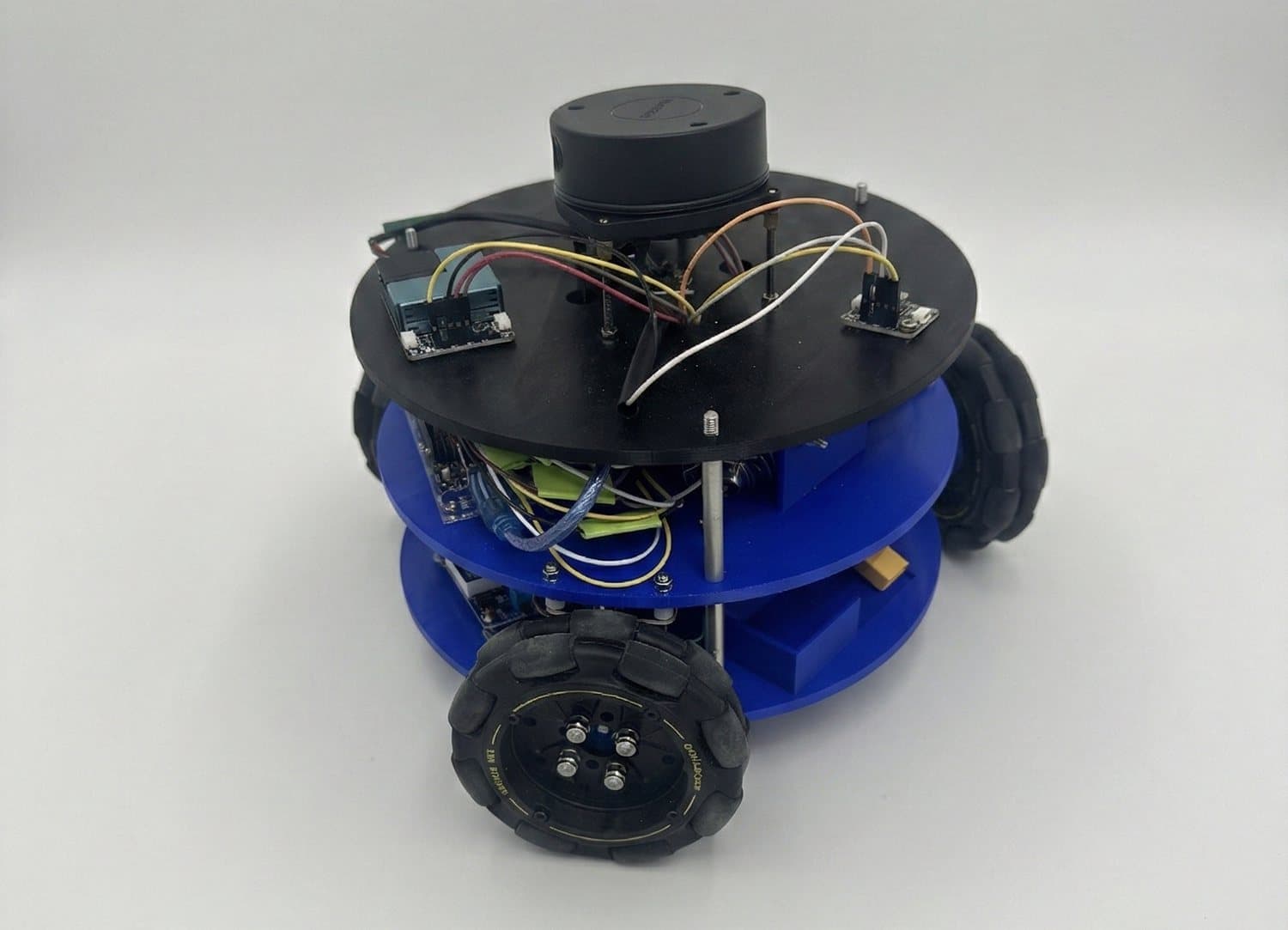
Custom two-deck mobile robot with a top-mounted LiDAR, air-quality sensor boards, and omnidirectional wheels

Fixed air-quality sensors are blind between the dots. So I built a mobile one: a hand-wired robot that drives itself through a room on LiDAR-SLAM, samples CO₂ and PM₂.₅ every two seconds, and fuses those readings into a live map of the invisible. A single robot becomes a whole virtual sensor grid — and then climbs the concentration gradient to find where the pollution is coming from.

Spinning laser scanner that builds the map and localizes the robot in real time (SLAM) — every air reading gets an accurate x, y position.

Tap a marker to inspect the build

0.74 m
source located within
2 s
sampling cadence
4
signals — CO₂ · PM₂.₅ · temp · RH
24→1
fixed-sensor grid replaced by one robot

A closed loop, on real hardware

It's a closed perception–decision–action loop running on real hardware: sense → localize → fuse → decide where to look next. One self-calibrating robot replaces a rack of fixed sensors, and lays the groundwork for multi-robot cooperative sensing and AI-driven ventilation control.

01

Sense

CO₂, PM₂.₅, temperature and humidity streamed every 2 s — each reading timestamped at the source.

02

Localize

2D LiDAR SLAM maps the room and position-tags every measurement, turning a moving robot into a dense grid of virtual sensors.

03

Fuse

Kalman filtering and inverse-distance weighting smooth the sparse trajectory into a continuous, room-wide pollutant field.

04

Locate

Gradient-ascent search climbs the reconstructed field to the emission source — pinned to within ~0.74 m of the true location.

  • Raspberry Pi
  • Arduino
  • ROS 2
  • 2D LiDAR
  • SLAM
  • Occupancy Mapping
  • CO₂ (NDIR)
  • PM₂.₅ (laser)
  • Temp
  • Humidity
  • Kalman Filter
  • Inverse-Distance Weighting
  • Gradient-Ascent Source Localization
  • Adaptive Sampling
  • Omni-drive
  • DC motors
  • Untethered
  • Python
  • Semantic Mapping
  • Sensor Fusion
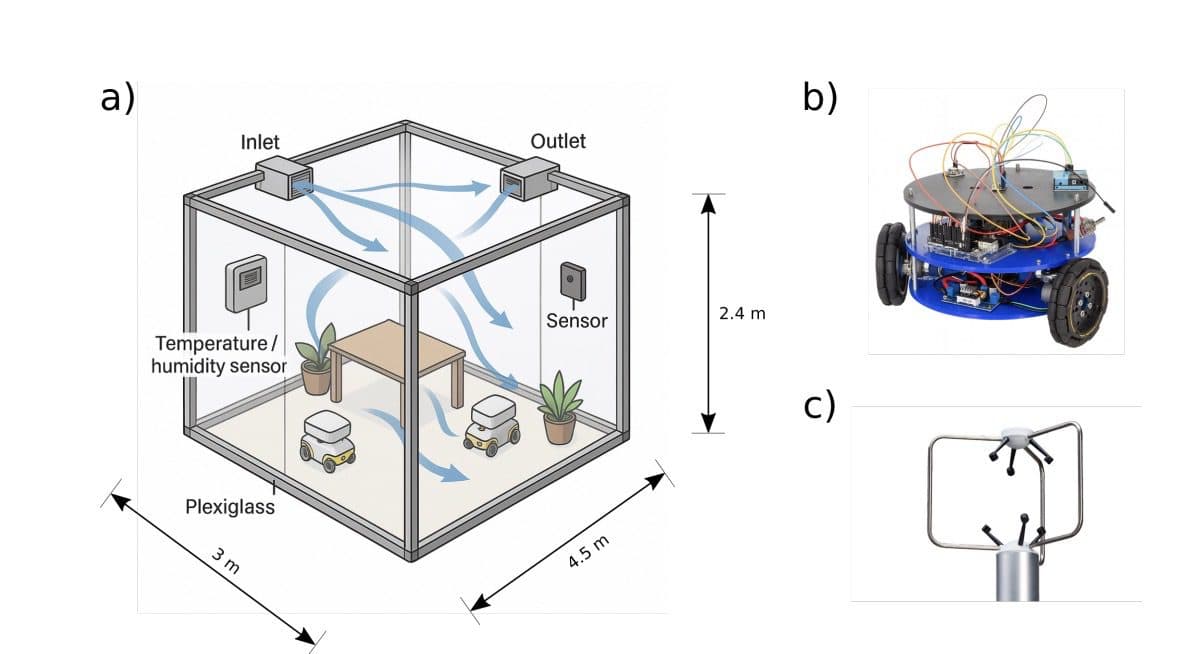
Diagram of the controlled test chamber with ventilation inlet and outlet, the robot, and a wall sensor
Controlled test chamber (3.2 × 4.2 × 2.45 m) with steady inlet/outlet ventilation — where the robot and fixed sensors were validated against a known smoke source.
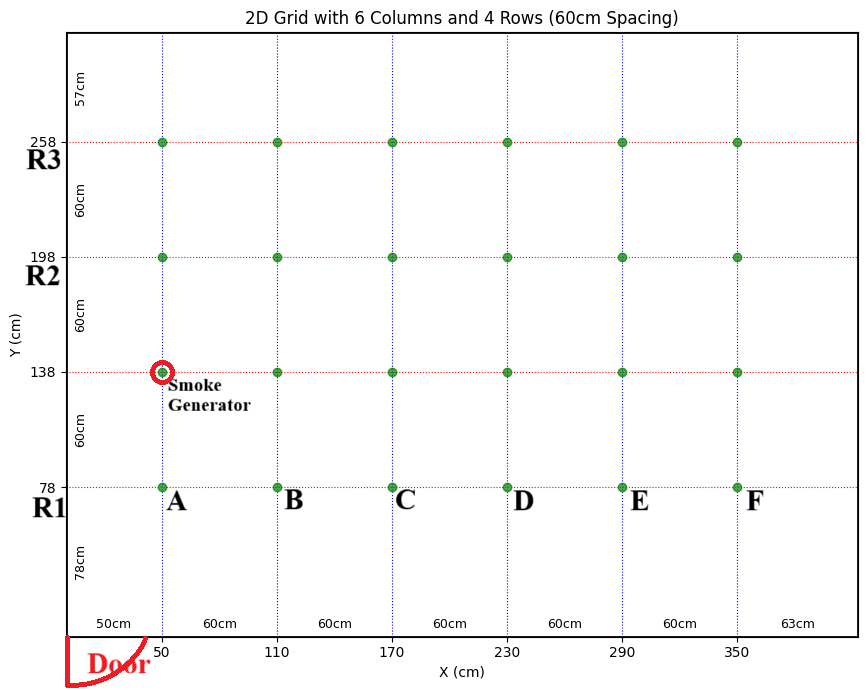
2D grid of 6 columns by 4 rows of measurement points with a smoke generator marked
The virtual measurement grid: 24 points at 60 cm spacing across three heights, with a smoke generator as a ground-truth pollution source.

Robot-in-the-Loop Indoor Air Quality Mapping and Source Localization Using LiDAR-SLAM and Multi-Pollutant Sensing

Chahardoli, S., Sarker, A., Lesan, M., Xiao, Y., & Bhattacharya, A.

Indoor Air 2026 (forthcoming)

Peer-reviewed work

  1. 2025

    Analysis of the Effects of a Swing Door Opening on Indoor Airflow Fields — An Experimental Study

    Chahardoli, S., Nikoopayan Tak, M. S., Lesan, M., Mousavi, E., & Bhattacharya, A.

    Buildings, 16(1), 54

  2. 2025

    The Synergy of Ventilation System Layouts and Occupant Arrangements on Ventilation Effectiveness: A Case Study in a Shared Office

    Lesan, M., Chahardoli, S., & Bhattacharya, A.

    Buildings↗ DOI

  3. 2024

    The Effects of Diffuser Location on Ventilated Airflow — A Numerical Simulation Study

    Chahardoli, S., & Lesan, M.

    ASHRAE Transactions, 130, 775–783

  4. 2024

    Radiative Cooling Ventilation Improvement Using an Integrated System of Windcatcher and Solar Chimney

    Khakzand, M., Deljouiee, B., Chahardoli, S., & Siavashi, M.

    Journal of Building Engineering↗ DOI

  5. 2023

    The Relationship Between IAQ (CO, CO₂, PM2.5, PM10), Air Outlet Location and Emission Behavior in Healthcare Facilities (Namazi Hospital, Shiraz)

    Farhadi, F., Khakzand, M., Altan, H., & Chahardoli, S.

    International Journal of Ventilation↗ DOI

  6. 2023

    Indoor Air Quality in Health Care Units (Case Study: Namazi Hospital, Shiraz, Iran)

    Farhadi, F., Chahardoli, S., & Khakzand, M.

    IntechOpen↗ DOI

  7. 2022

    Numerical Analysis of the Effect of Roof Types and Porch on Particle Dispersion and Deposition Around a Low-Rise Building

    Chahardoli, S., Khakzand, M., Faizi, M., & Siavashi, M.

    Journal of Building Engineering, 53, 104533

  8. 2022

    Comparative Study of Architectural Elements to Improve the Wind Environment in Hot and Humid Climates

    Khakzand, M., Chahardoli, S., Niknejad, A., & Khanijazani, T.

    Journal of Design and Built Environment

  9. 2021

    Indoor Thermal Comfort and High Residential Buildings (Case Study: Two High-Rise Buildings in Tehran)

    Khakzand, M., & Chahardoli, S.

    Journal of Urban Management and Energy Sustainability (JUMES)↗ DOI

Full list on Google Scholar ↗

Experience

Data Scientist / AI Intern

Hart Howerton

Applying data science, machine learning, and AI to design, planning, and analytics workflows at a leading planning, architecture, and landscape architecture firm.

Graduate Research Assistant

Dept. of Construction Management, Louisiana State University

Built a ROS-based mobile sensing pipeline; trained Transformer/RNN forecasting and PPO control policies; ran CFD studies validated against sensor data.

Lecturer

Various Universities

Delivered complex technical coursework across 30+ sessions at multiple institutions.

Project Management Intern

Pahneh Band Consulting Engineers, Tehran

Participated in all phases of design and construction.

Education

Ph.D., Construction Management

Louisiana State University

Optimizing Indoor Air Quality and HVAC Systems using AI and Robots.

M.Sc., Computer Science

Louisiana State University

Thesis: Prediction of Airflow Distribution using EBM and AI.

M.Sc., Architectural Engineering

Iran University of Science and Technology, Tehran

Thesis: Modeling particle dispersion around buildings using CFD.

B.Sc., Architectural Engineering

Malayer University

Project: Research & simulation of houses' energy consumption.

Honors & Awards

  • 2nd place, poster presentation — Dept. of Construction Management, LSU (2025)
  • Tuition fee waiver, Iran University of Science and Technology — top 0.25% in the national master's entrance exam
  • Top 5% in the national B.Sc. university entrance exam, Iran (2013)
  • 2nd prize, contemporary shelter design for post-natural disasters — Iranian Red Crescent
Download full CV ↓

Let's build something
intelligent.